
We can't wait to hear from you
Connect
Discover how TMI credentials are designed to accelerate your career growth. Explore how TMI incorporates Talent Management into the practice and systems of Human Capital Management. Learn how you can steer your future confidently through TMI's research driven Talent Management standards. Fellow programs equip global HR professionals with the latest in Talent Management in the transformational way.
Explore how the TMP™, STMP™, and GTML™ credentials can take your HR career places, or add to the capabilities of your promising HR staff and leaders.
View CertificationsStrengthen your enterprise HR system by implementing the TMI-ETMS™ international standards.
Learn About TMI-ETMS™If you are interested in consulting, training or education, partner with TMI to join the global league of TMI aligned institutions, companies and industries.
Become a TMI PartnerLearn the latest about how Talent Management is transforming HR into a future oriented business hyperfunction.
Explore the TMI ApproachLearn the steps to earn your TMI certification, from application to successful completion and maintaining your credential.
TMI credentials include globally recognized digital badges, offering a portable and verifiable representation of your achievements.

Kickstart your Talent Management journey with TMI’s globally recognized certifications and resources to excel in your career.
Create myTMI Account TodayTMI Global and Associate Fellow programs turn HR professionals into global Talent Leaders who can drive growth with their superlative strategic ability, business perspective and readiness for change. Since 2024, more than 150 senior HR professionals and HR leaders from 46 global organizations across industries have completed these programs that establish new standards for the practice of talent management as a driver of organizational success and business competitiveness.
You can contact us here for more information.

TMI–ETMS10™ and TMI–ETMS14™ certified organizations are effective for restructuring Talent Management in an organization. With TMI, organizations are better, more agile and better prepared for challenges that are to come.

The TMI-Enterprise Talent Management Standards power enterprise HR with the latest in Talent Management.
To choose a TMI–ETMS™ version most appropriate for your organization!
Write to us via the contact form.

Partnering with TMI means building a powerful structure of Talent Management thought and practice resulting in business profits through standards, certifications and networks.
Get your HR staffers and managers TMI certified on Talent Management by adding TMI into your training regimen. One step toward embedding TMI credentials in your institutions curricula is to become a TMI-ETMS™ consulting partner. Join us to be a part of the groundbreaking work of Talent Management.

If you hold an elite international qualification in HR or a related discipline, possess a recognized HR credential, or studied HRM at a TMI-recognized institution, you may be eligible for an accelerated pathway to a TMI credential through QualiFly™ leading to TMP™, STMP™ or GTML™.
 Institutions
Explore Certification Bodies, Universities, B-Schools & Other Institutions recognized by TMI under the Q1, Q2, and Q3 Lists.
Check if your institution is recognized
TMI’s blogs cover the latest trends, insights, and best practices in HR and talent management.
Comprehensive guides covering talent development, HR metrics, key facts, and more.
Explore TMI's latest updates, announcements, news and press releases in our newsroom.
Strategic insights driving the future of talent, leadership, and global workforce excellence.
Dive into the inspiring journeys of TMI certification holders and learn how the certification has transformed their careers.
An Interview series featuring key advice from global talent leaders for future HR professionals.

A future-ready workforce is becoming a competitive requirement as skill requirements, work design, and talent needs continue to change. Work is changing faster than many organizations can build new capabilities through hiring alone. In the World Economic Forum’s Future of Jobs Report 2025, employers project that job disruption will affect 22% of jobs by 2030. The report projects 170 million new roles and 92 million displaced roles by 2030, resulting in a net increase of 78 million jobs.
Capability resilience has also become a strategic concern. The World Economic Forum estimates that 39% of key skills required in the job market will change by 2030. In the United States, the U.S. Bureau of Labor Statistics projects about 19 million job openings annually, on average, from 2024 to 2034, with most openings resulting from replacement needs as workers leave the labor force or move to different occupations.
These trends make workforce readiness a question of capability development, internal mobility, and talent retention alongside external hiring. Artificial intelligence (AI) is accelerating changes in how work is designed and performed, increasing the need to identify emerging skills and adapt workforce strategies.
A future-ready workforce is the outcome. A future-ready talent strategy is the approach used to build that workforce. The distinction matters because workforce readiness depends on more than training. Organizations also need systems that anticipate capability requirements, develop existing talent, create opportunities to apply skills, and connect workforce decisions to business priorities.
Talent strategy is increasingly focused on connecting workforce planning, skills development, internal mobility, and career opportunities. Three shifts are particularly important:
Organizations are recognizing that workforce capability depends on skills visibility and deployment alongside skills development. A survey cited in a Gartner press release reports that only 8% of organizations have reliable skills data, while fewer than 20% effectively move talent to fill skill gaps.
Learning and development (L&D) remains an important part of this system. Manager incentives, workforce structures, and internal mobility policies also influence whether skills can be identified, developed, and applied to priority work.
Career development is another important component. Gartner found that only 46% of employees feel supported in trying to grow their careers at their organization. Gartner research on career development Strengthening career growth and internal mobility can therefore support both employee retention and capability development.
Future-ready talent strategies also need to account for human capabilities such as problem-solving, collaboration, adaptability, and learning agility. As technology changes work processes, these capabilities can influence how effectively employees respond to new requirements.
Skills-first approaches can expand access to roles and development opportunities when organizations assess demonstrated capabilities alongside formal credentials. They require reliable skills data, consistent assessment, and appropriate governance. Skills-first practices do not automatically produce more diverse outcomes, so organizations also need to monitor how talent decisions affect different employee groups.
Diversity, equity, and inclusion (DEI) can support workforce readiness by improving access to development and career opportunities. Research from McKinsey & Company has identified a relationship between leadership diversity and financial performance. These findings do not establish causality on their own, but they help explain continued interest in representation and fair opportunity as components of organizational effectiveness.
A future-ready talent strategy provides a repeatable approach for identifying changes in work, translating them into capability requirements, and connecting talent decisions to business priorities.
Three core components provide the foundation:
Strategic workforce planning (SWP) connects business priorities with workforce requirements. McKinsey argues that SWP has become increasingly important in the age of generative AI because it connects HR, operations, and financial priorities to resource allocation. Its research estimates that activities accounting for up to 30% of current worked hours could potentially be automated by 2030. McKinsey on strategic workforce planning in the age of AI
This estimate refers to the potential automation of work activities rather than suggesting that 30% of jobs will disappear. The broader implication is that workforce planning needs to account for changes in how work is performed, alongside changes in headcount.
Effective workforce planning therefore requires scenario analysis, capability forecasting, and a connection between business priorities, work requirements, and talent decisions.
Skills intelligence provides visibility into the capabilities an organization has and those it may need in the future. It can help leaders identify capability gaps, prioritize development investments, and make more informed decisions about hiring and internal talent deployment.
Skills information can come from skills taxonomies, work history, credentials, assessments, and manager validation. The appropriate combination depends on how the information will be used.
Data quality becomes particularly important when skills information influences access to roles, compensation, promotion, or development opportunities. Clear definitions, consistent assessment methods, and governance are necessary to keep these decisions credible.
Capability development creates greater value when employees can apply new skills to meaningful work. Opportunity-based talent deployment connects employees with roles, projects, assignments, mentoring opportunities, and other forms of internal experience.
Internal talent marketplaces are increasingly being used for this purpose. They can make opportunities more visible and help organizations connect employee capabilities with areas of demand.
Technology alone does not create effective internal mobility. Organizations also need supportive policies, manager participation, transparent selection processes, and clear pathways for employees.
Learning systems, leadership practices, employee experience, technology, and governance support all three components. Together, these elements help organizations develop and deploy talent as workforce requirements change.
The five examples below illustrate different approaches to building workforce readiness. Some emphasize learning and reskilling, while others focus on internal mobility, talent marketplaces, or workforce redeployment. Recurring elements include greater visibility into skills, development opportunities, and mechanisms for applying talent where it is needed.
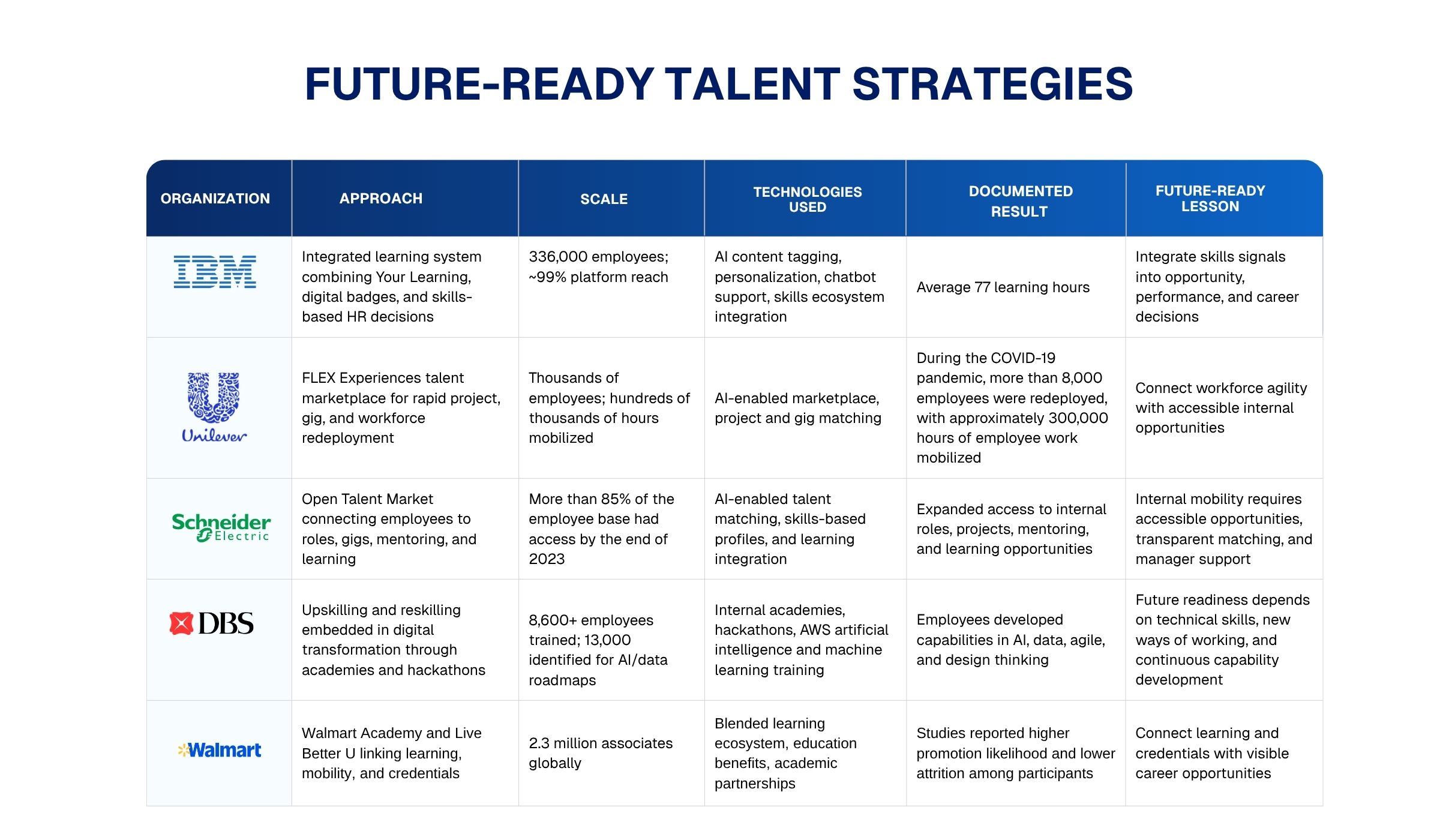
These examples demonstrate different implementation models rather than a single formula. Across them, recurring practices include making capabilities more visible, providing development opportunities, and creating ways for employees to apply their skills through roles, projects, or other opportunities.
Four barriers can limit the effectiveness of a future-ready talent strategy.
Skills opacity makes it difficult to understand the capabilities an organization has today or may need tomorrow. Without reliable skills intelligence, organizations have limited ability to target development investments or make informed internal talent decisions.
Mobility friction can prevent organizations from using existing capabilities effectively. Managers may be reluctant to release talent, internal job structures may be rigid, or employees may lack clarity about available opportunities.
Learning and work mismatch can also limit capability development. Short-form learning can support specific knowledge and skill needs, while more substantial capability changes may require structured pathways that combine learning, practice, feedback, and application.
Trust and governance become particularly important when AI is used in talent processes. Research on AI in HR indicates that AI can introduce or reinforce bias depending on data quality, system design, transparency, and oversight. Regulatory expectations and data protection requirements reinforce the need for appropriate governance when AI influences employment-related decisions.
Research and examples from leading organizations point to seven practical practices.
Identify the work the organization needs to perform and the capabilities required to deliver it. Then determine which capabilities can be developed internally, acquired externally, or built through redeployment.
Use demonstrated capabilities alongside formal credentials when making talent decisions. Reliable skills data can support talent deployment, internal mobility, workforce development, and workforce planning.
Internal mobility requires clear policies, accessible opportunities, manager enablement, transparent selection processes, and systems that make relevant roles and projects visible.
Learning pathways need to accommodate working adults while providing sufficient depth for meaningful capability development. Modular learning and learning in the flow of work can help employees apply new knowledge in relevant contexts.
Problem-solving, collaboration, adaptability, and learning agility can become increasingly important as technology changes work. Organizations also need team environments that support experimentation, feedback, and new ways of working.
Use consistent criteria for access to development, projects, internal roles, and career opportunities. Monitor outcomes across employee groups and assess whether talent systems create unintended barriers.
AI governance should address data quality, transparency, human oversight, privacy, fairness, and accountability. Organizations should establish clear responsibilities for reviewing AI-enabled talent processes and monitoring their outcomes.
Future readiness should be measured through several complementary KPI categories.
Skills and capability metrics can include skills data coverage, validated proficiency rates, time to proficiency, and skills adjacency for priority roles.
Talent flow and opportunity metrics can include internal mobility rates, participation in strategic projects, cross-functional staffing, and the time required to fill critical roles and projects.
Employee experience and retention metrics can include career growth support, career-path clarity, learning engagement, and retention differences among pathway participants.
Business value metrics can include productivity, quality, risk outcomes, customer experience, and cost avoidance, depending on the organization’s operating model.
Equity and compliance metrics can include participation and mobility outcomes across demographic groups, adverse-impact monitoring for algorithmic tools, AI process audits, and privacy or security incidents associated with talent technology.
A balanced measurement approach helps leaders determine whether capabilities are being developed, deployed, and translated into business value.
Talent strategy is moving toward models that place greater emphasis on capabilities, workforce mobility, continuous development, and changing work requirements. Organizations are increasingly assessing how quickly employees can develop and apply new skills as workforce needs evolve.
Internal talent marketplaces are creating additional ways to connect employees with projects, assignments, mentoring opportunities, and roles. AI is also influencing how work is designed, allocated, and supported. As these technologies become more closely integrated with talent processes, governance, transparency, data quality, and human oversight become increasingly important.
For talent leaders, workforce readiness depends on connecting business priorities with the capabilities required to deliver them. Workforce planning helps anticipate changing needs. Skills intelligence provides visibility into available capabilities. Internal opportunities allow employees to develop and apply those capabilities.
Organizations that can develop and deploy talent as workforce requirements evolve will be better positioned to respond to changing skills needs, persistent talent constraints, and continued changes in how work is performed.


